

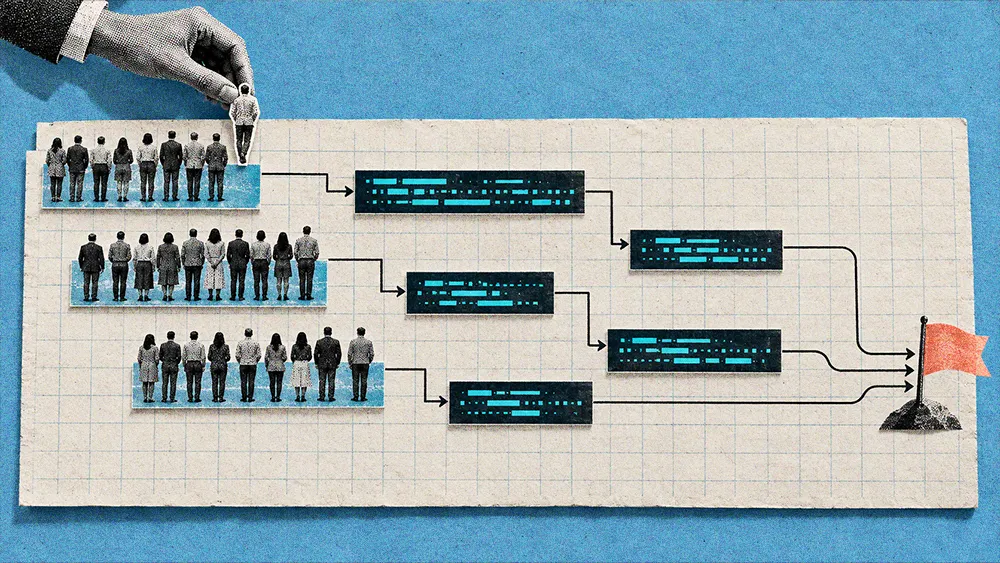
Most AI roadmaps schedule the build, the testing and the launch. They rarely schedule the hiring, which is usually the longest task on the plan.
Nearly seven in 10 technology leaders abandoned a project in the past year because their teams lacked the skills to deliver it, according to Pluralsight’s 2026 Tech Skills Report. AI projects were among those most at risk. Many of those failures can be predicted in advance. A technical hire takes about 10 weeks, and roughly one in four offers is turned down. Those numbers are well known, but roadmaps rarely include them. Teams that treat every open role as a project dependency, with its own date and buffer, hit their launch dates. Teams that wait until kickoff to open requisitions often launch a quarter late.
Key findings
Nearly 7 in 10 tech leaders abandoned a project in the past year because their teams lacked the needed skills, per Pluralsight’s 2026 Tech Skills Report.
84% say skills gaps push projects over budget at least some of the time.
Technical roles take about 10 weeks to first fill, and their offers are accepted 73% of the time, compared with 84% for business roles, per Ashby.
Remote technical roles see 13% higher offer acceptance than in-office roles, per Ashby’s startup hiring data.
Firms that mandated a return to the office took 23% longer to fill vacancies: 63 days instead of 51.
The task that isn’t on the plan
A typical AI roadmap lists milestones: data pipeline ready, model trained, evaluation passed, integration done, launch. Each one assumes the people to do the work are already on the team. Often they aren’t. As Talent Observer covered in AI pilots stall on staffing, moving AI from pilot to production takes data, platform, evaluation and integration roles that most pilot teams don’t have.
The hiring for those roles happens on a separate track, run by a different team and governed by a different budget cycle. Engineering commits to a date. Recruiting gets the requisition later, sometimes after the project has already started. Nobody connects the two timelines until the launch date starts to slip.
Skills gaps cost money as well as time. Eighty-four percent of tech leaders say skills gaps push projects over budget at least some of the time. More than three-quarters said they’ve seen employees finish training or earn certifications and still be unable to apply the skills on the job. That’s one reason retraining can’t always close the gap before a deadline. Plans that assume hiring will be quick, or that training will fill the gap, are likely to slip.
Work backward from the launch date
Here’s the timeline for a team that wants an AI feature live by July 1, 2027, and needs three hires to get there: a data engineer, an MLOps engineer and an ML engineer.
Launch: July 1.
Build and test (about 12 weeks with the full team): the team has to be productive by early April.
Ramp-up (about four weeks to learn the systems and data): start dates by early March.
Notice period (typically two weeks in the US): accepted offers by late February.
Time to fill (about 10 weeks for technical roles, per Ashby data as covered by Talent Observer): requisitions open by mid-December.
Buffer for one declined offer (about four more weeks): requisitions open by mid-November.
For a July 2027 launch, the requisitions need to be open before the prior calendar year ends. That assumes all three roles are hired in parallel. Hired one at a time, at 10 weeks each, the third engineer wouldn’t start until well into the summer, after the build should have finished.
The calendar adds its own pressure. Hiring slows in December as candidates and interviewers take time off. Many ad tech teams also freeze production changes for the fourth-quarter peak, so a late hire may not be able to ship anything until January.
The build, ramp and buffer figures above are planning assumptions, not benchmarks. Teams should use their own numbers. The point is that once each step is laid out, the requisition date usually turns out to be much earlier than the roadmap assumed.
A declined offer is a scheduling risk
Ashby’s data shows technical offers are accepted 73% of the time. For a single hire, that sounds manageable. For a team, the odds compound. If a project needs three engineers and each first-choice offer has a 73% chance of being accepted, there’s only about a 39% chance that all three first offers land. The odds are better than even that at least one falls through.
Each declined offer sends the search back to the remaining candidates, or back to sourcing if no strong backup is left. Plans that don’t account for that are, statistically, more likely to slip than not.
Adding more interviews doesn’t fix the problem. Companies now interview 52% more candidates per technical hire than in 2021, and technical offer acceptance hasn’t improved.
What the teams that hit their dates do differently
Teams that ship on schedule handle hiring like any other critical-path work.
Hire in parallel. Open every role the project needs at the same time instead of filling them one by one.
Open requisitions when the roadmap is approved, not at kickoff. If funding for the headcount is the obstacle, settle it in the same planning cycle that approves the project.
Settle salary bands before the search. A band that needs a new approval after the final interview adds days at the point where candidates are most likely to accept another offer.
Offer remote where the work allows. Ashby’s startup hiring data shows remote technical roles get 13% higher offer acceptance. Research Talent Observer covered found that firms with return-to-office mandates took 23% longer to fill vacancies.
Search beyond one city. AI and data skills are now the hardest to hire worldwide, and shortage rates vary widely by country. A broader search shortens the 10 weeks.
Cover the gap with contract specialists. An experienced contractor can start on the critical path while the full-time search continues, paired with a full-time owner who keeps the knowledge.
Put hiring on the roadmap
The simplest fix is to make each hire a line item on the project plan. Give it a target start date, an owner (usually the hiring manager), a buffer for a declined offer, and a status that gets reviewed in the same meeting as the technical milestones. When a requisition falls behind, the project should show as at risk, just as it would if a dependency in the code fell behind.
Engineering leaders already plan carefully around technical dependencies. Hiring is often the longest dependency on the plan, and it deserves the same attention.
Frequently asked questions
How long does it take to hire a software or ML engineer? About 10 weeks to first fill a technical role, according to Ashby data, compared with eight weeks for business roles.
When should we open requisitions for an AI project? Work backward from the launch date: build time, ramp-up, notice period, about 10 weeks to fill, plus a buffer for a declined offer. For a mid-2027 launch, that usually means opening roles in late 2026.
How often do engineers turn down job offers? Technical offers are accepted 73% of the time, compared with 84% for business roles, per Ashby. Roughly one in four technical offers is declined.
Do skills shortages actually delay projects? Yes. Nearly seven in 10 tech leaders told Pluralsight they abandoned a project in the past year because their teams lacked the skills, and 84% said skills gaps push projects over budget at least some of the time.
Should we hire for an AI project one role at a time or all at once? All at once when possible. At 10 weeks per technical hire, filling three roles one at a time takes about seven months. Filling them in parallel takes about one quarter.
Does offering remote work speed up technical hiring? It improves acceptance. Ashby found remote technical roles get 13% higher offer acceptance, and firms with return-to-office mandates took 23% longer to fill vacancies.
Do more interview rounds lead to better technical hires? Not by the acceptance measure. Companies now interview 52% more candidates per technical hire than in 2021, and technical offer acceptance still sits at 73%.
How can we keep a project on schedule while hiring is still open? Bring in contract specialists for critical-path work while the full-time searches close, and pair each one with a full-time owner who keeps the knowledge.