

People are going to weigh how much energy or effort it's going to take to undergo a change against the return they're going to get from it. If it seems too far away or not clear, they're going to likely resist it.
 Ceara Lane MZEVP of Operations and People @ Law & Crime and Court TV
Most technology rollouts are framed as a technical problem when the real obstacle is human arithmetic. Before anyone adopts a new tool or workflow, they run a calculation: how much effort will this cost me, and what do I actually get back? When the answer is unclear, or when the benefit accrues to the company while the cost lands on the individual, people resist. That resistance is often read as stubbornness or fear of technology, but it's usually something more rational than that, and it responds to a completely different set of moves than a top-down mandate.
Ceara Lane MZ, EVP of Operations and People at Law & Crime and Court TV, has spent nearly two decades building and scaling people and operations functions across startups, founder-led companies, and organizations moving through acquisitions and rapid growth. Her work now spans operations, AI adoption, and organizational design, a vantage point that sits deliberately at the intersection between the systems a company installs and the people who have to use them. It's the intersection where Lane MZ sees most change efforts succeed or fail.
"People are going to weigh how much energy or effort it's going to take to undergo a change against the return they're going to get from it. If it seems too far away or not clear, they're going to likely resist it." For Lane MZ, that calculation is the whole game, and everything about how she rolls out change is designed to shift the math in the employee's favor.
Resistance is energetic, not just emotional
Lane MZ frames resistance not just as a feeling to be managed, but an assessment of cost against return. People make it whether or not a leader has given them the information to make it well. "Change is more than just emotional. It's energetic," she says. "The way people work affects their quality of life. If you change that for them and they don't see why you're changing that or what the benefit is, it's going to impact their morale, it's going to impact whether they adopt, it's going to impact so many things."
The implication for anyone leading a rollout is that the first job isn't persuasion, but clarity. Employees need to understand why the change matters and what they specifically will get from it, and they need to be able to see it rather than take it on faith.
Peer proof beats top-down compliance
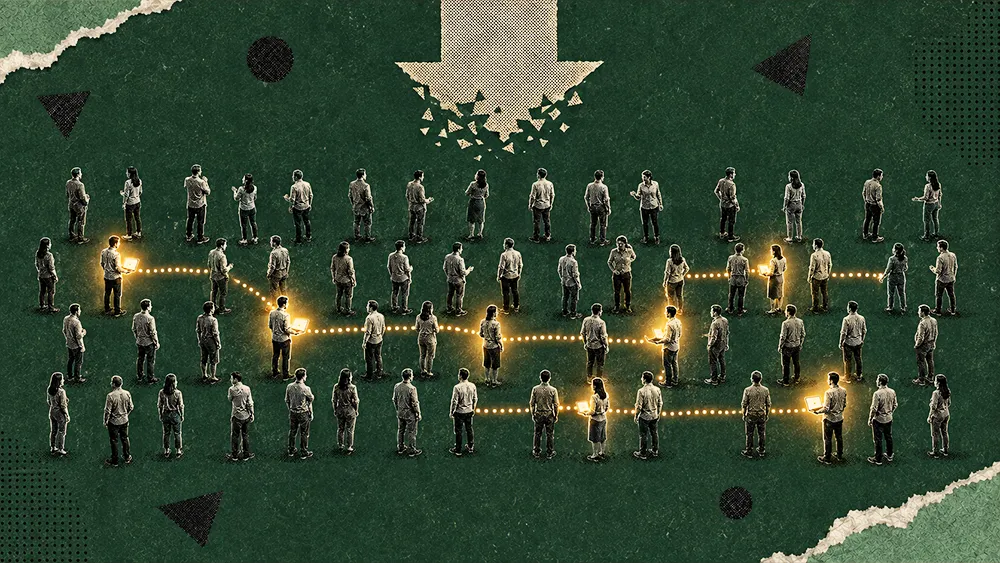
A concrete illustration comes from how Lane MZ's company drives AI adoption, a change nearly every organization is wrestling with right now. Rather than mandating usage, the company built a program to surface and amplify the people already succeeding with it. "Monthly we surface the top users of AI in the company and then we ask them about what they're using, why they're using it, what's surprising about it. Then we have them speak in company meetings about how they're using AI," she shares. The effect is that adoption spreads horizontally, through colleagues, instead of being pushed down from leadership. "With peer to peer introduction of change, it goes a lot easier than if we're just doing top-down compliance."
Lane MZ points out that the psychology here is familiar from ordinary life, where a friend's visible success is far more persuasive than an abstract directive. Someone watching a peer get real value from a tool starts asking how to try it themselves, which is a very different starting posture than being told they must. It also defuses the specific fear that drives a lot of AI resistance, the worry that the tool exists to replace them rather than to extend what they can do.
Close the gap between company payoff and personal cost
The hardest version of the problem is when the benefit is clearly organizational, like more output or scale without added headcount, while the cost falls entirely on individuals who have to learn something new. Lane MZ is direct that a leader can't wish that gap away, but there is almost always a personal payoff to be found if you look for it. "You have to figure out what the payoff is at the individual level. And there usually is one," she says.
Her method is to bring people into the process early, identify a handful of employees who believe in the change, and let them help diagnose the problem so they become early adopters rather than targets of the rollout. "If you can understand their mindset and what's important to them and you can link that to what's important for the company, then that's a perfect opportunity."
The failure mode she warns against is assuming authority is sufficient. When leaders change how people work without making the reason legible, the fallout isn't limited to slow adoption. It shows up in morale and in trust, because the way people work shapes their daily life more than leaders often account for.
Why systems thinking is the missing lens
Part of what a purely technical leader can miss, in Lane MZ's view, is the full chain of how work moves through an organization and lands on the people doing it. She locates the future of her own function precisely at that junction. "I believe the future of HR is at the intersection of people and operations, because any operations or systems that you're going to implement are directly impacting people or people need to use them," she explains. A technical leader might correctly design a system to accomplish a task while missing whether it actually makes the work easier for the person doing it, or whether it unintentionally introduces new obstacles.
When work is made genuinely more efficient for people, Lane MZ notes, they're not only more satisfied, the work itself flows more smoothly through the company.
Adaptability can be hired for, but clarity still has to be earned
The question of whether you can screen for change-readiness at the hiring stage has a two-sided answer. Lane MZ does screen for adaptability, especially for startup environments where building amid ambiguity is the job. "You can ask for examples of what they've gone through, how they work best," she says. But she's clear that even the most adaptable hire will struggle with a change that doesn't make sense to them, which returns the burden to leadership. Adaptability lowers resistance, but it doesn't eliminate the need for a legible reason. The clarity still has to be provided, no matter how change-ready the team is.
For a technical leader about to ask a team to absorb something big, Lane MZ's advice compresses to a single move. "Involve the people affected by the change early. You need buy-in in order to have success." The rollout hinges on the people who will champion it, and no leader can carry the weight of a change alone.