
The one-to-one trust we build with people is the most important thing we have.
 Josh FialkyTalent Acquisition Leader
Fake recruiters are having a moment, and the reason is structural. A tight job market, layoffs stacked across advertising and tech, and a flood of AI-generated content have made it easy to impersonate a company, spin up a fake careers page, or clone a real employee's identity and message candidates. The usual response treats this as a candidate-awareness problem, and the solution as teaching people to spot the red flags. The more useful lesson for the teams being impersonated is that a distinctive, consistent, unmistakably human hiring process is becoming a defense. When the real process is recognizable, the fake one stands out, and employer brand starts doing the work of a security control.
Josh Fialky is a Talent Acquisition Leader who spent more than 25 years across media, advertising, and search marketing before moving into in-house recruiting. He's since spent roughly a decade building and leading TA teams and running executive search. Fialky's combination of deep technical fluency plus years in the recruiter's seat makes him uniquely equipped to see how the latest round of impersonation works and why it succeeds.
"Recruiting is a relational business, not a transactional one. It's human first," he says. That principle turns out to be more than a philosophy for good hiring, and the scams expose why.
The impersonation comes from several directions at once
The attacks Fialky has seen on his company and others aren't a single trick, but a family of them, and the first wore a real employee's face. "Someone on the HR team, they actually stole her name, created a fake LinkedIn profile, and started reaching out to people directly saying, 'We have a job here. Send me your information,'" he says. Because it impersonated an actual individual, it resisted the usual takedown. "It took us a few weeks of working with LinkedIn to get that removed."
A second attack forged the company itself. "They created a fake company page and posted fake roles. This one hit home because it was for a talent acquisition coordinator, on my team, and we're not hiring," he says. The detail that added insult to injury was the salary. "The salary they posted was 30 to 40 percent more than what that role pays," he says, pointing out that it not only lured desperate applicants, but unsettled existing employees who wondered why they'd never heard about the opening.
The largest episode was a fake recruiting agency operating at scale, and what stands out is how fast the real team caught it. "On a Monday morning one of my recruiters said someone contacted her about it, and by the end of the day we had at least 100 people reach out saying this looked too good to be true," Fialky shares. None of these involved a technical breach. They exploited trust and the visible surface of an employer's brand. The target? All the sensitive data a new hire readily hands over. "It's so much personal information all in one place that an attacker can really run away with it."
The market conditions are the exploit
The reason these scams land is psychological, and Fialky is clear-eyed that a battered job market is the vulnerability. "You have all these people who've been out of work for months, in some cases a year plus," he says. "They're so willing to get back to work that they sometimes ignore what looks too good to be true." The replies he got when he contacted targets confirmed it. "They said things like 'I was so excited to hear from you, this opportunity sounds right up my alley.'"
He places the fraud inside a longer erosion of trust recruiters have already strained through years of ghosting and roles pulled when budgets vanished, which makes a fake offer not an isolated con, but one more injury. "You're kicking people when they're down," he says.
AI has lowered the cost of looking legitimate
What once required effort now takes almost none, which is why impersonation scales. "You used to actually have to find people to reach out to and write the emails or InMails. Now you can do it in three clicks," Fialky notes. The same collapse in cost that makes a recruiter faster also makes a scammer indistinguishable from one, and as AI-generated profiles increasingly read alike, the old visual cues fade.
His answer is relentless verification. "If someone reaches out from a company, I go to the company page and see if I can find them. I look at the email domains to see if they match. I go on LinkedIn, see who they know," he says. "You need to double and triple check before responding to anything." The artifacts themselves are another tell. "The job description was written in a very different manner, different template and headers than the ones we use," he says of the fraudulent post for his team. "I knew it was fake because that's not how we write job descriptions." That recognition only works if the real thing is consistent enough to have a signature.
The human channel is the hardest thing to counterfeit
Fialky's solve is to make the real relationship an anchor for candidates because it's the one signal a scammer can't cheaply replicate. "Our recruiters are always going to reach out from our domain, with our email addresses, and have that distinct look and feel of how we present ourselves," he says. He also pushes recruiters to establish a visible personal presence. "It's more important than ever to build that personal brand on LinkedIn, at the company level but also the personal level, so people know who they're working with."
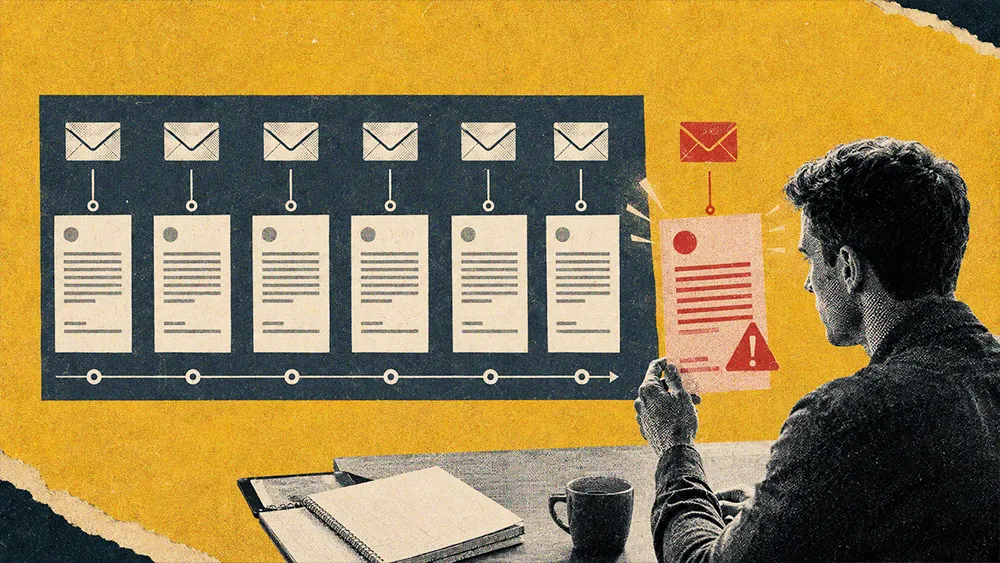
This very relationship is what led a candidate to catch the sharpest attack of all. "This was someone I'd been chatting with for six weeks, and she reached out and said, 'This looks very different from the emails you and I had passed back and forth,'" he says. A genuine history gave her a baseline the forgery couldn't match, which is the whole point: the human layer is no longer just what makes for a positive candidate experience. It's what makes the experience verifiable. "With so much being done by AI in recruiting, it's that human touch that separates a decent TA team from a great one," Fialky says. "The one-to-one trust we build with people is the most important thing we have."